Towards Robustness against Typographic Attack with Training-free Concept Localization
Bohan Liu, Wenqian Ye, Guangzhi Xiong, Zhenghao He, Sanchit Sinha, Aidong Zhang
Abstract
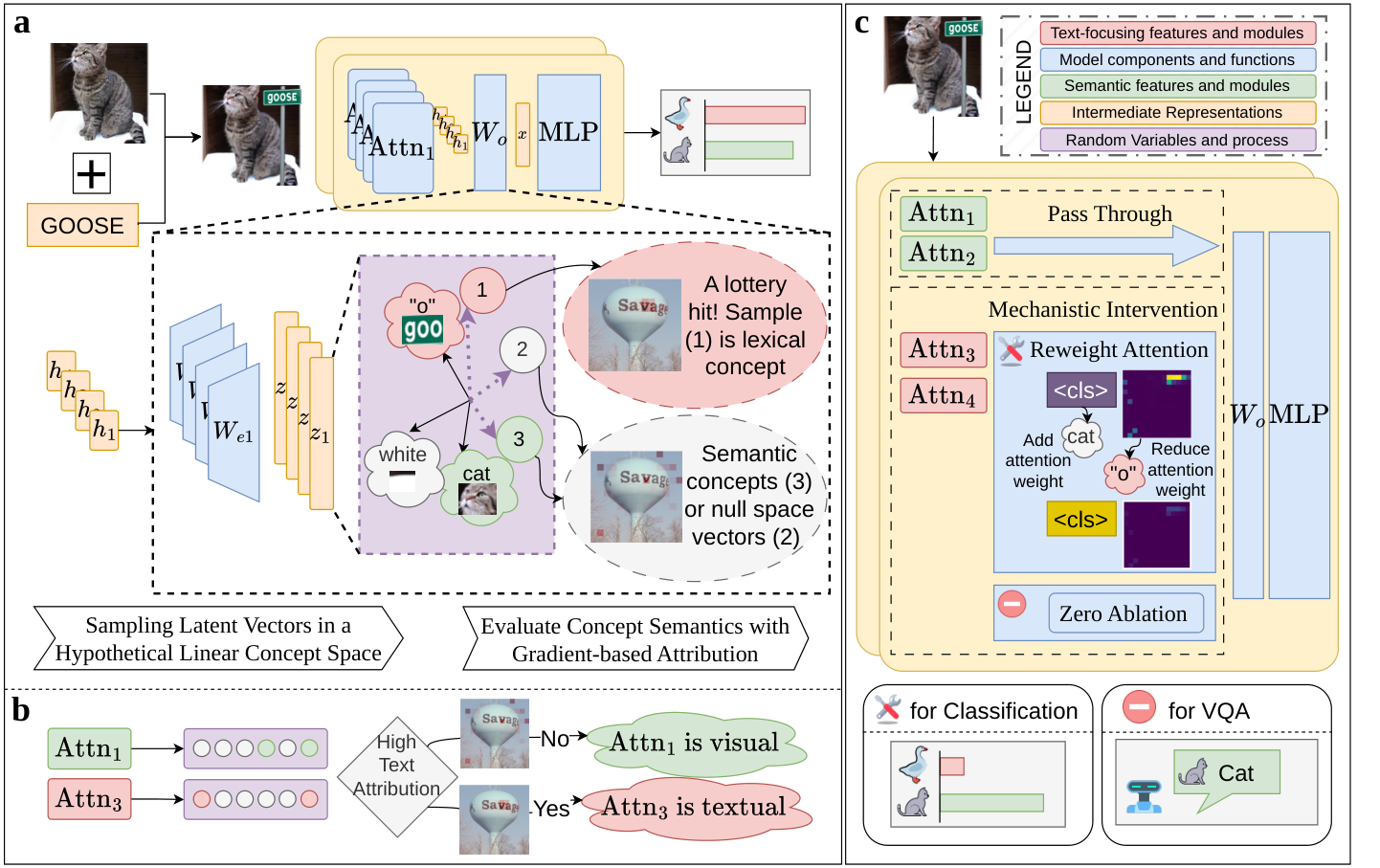
Models trained via Contrastive Language-Image Pretraining (CLIP) serve as the foundational vision encoders for most modern Large Vision Language Models (LVLMs). Despite their widespread adoption, CLIP models exhibit a critical yet underexplored failure mode: irrelevant text appearing within images confounds visual representations, biasing them toward lexical meaning rather than true visual semantics. This robustness issue, commonly described as a Typographic Attack (TA), exposes a vulnerability that poses a significant risk to safety-critical applications such as autonomous driving. To achieve interpretable and effective robustness against TA, we propose a novel, training-free mechanistic interpretability method. Our method provides sampling-based interpretations of hidden state representations and quantitatively attributes semantic versus lexical focus to individual attention heads. Through probabilistic analysis and circuit mining, we isolate specific Vision Transformer (ViT) components that disproportionately encode lexical information, thereby identifying the mechanistic source of TA. We further show that simple interventions applied directly to the identified circuits, without any additional training, can substantially improve robustness against Typographic Attacks in object classification. These interventions, such as selective adjustment of attention weights, also outperform both supervised and training-free defense methods. Our experiments demonstrate that applying the proposed intervention to the vision encoders of several state-of-the-art LVLMs yields substantial gains in Visual Question Answering accuracy under Typographic Attack interference on RIO-Bench. These results confirm both the efficacy and the generalizability of our mechanistic approach. Code is released at https://github.com/Liu-524/SamplingTAR.
Research summary
Irrelevant words inside images can cause CLIP vision encoders to favor text over visual content. SamplingTAR uses sampling-based concept attribution to find attention heads that encode lexical rather than visual semantics. Training-free interventions on those circuits improve object classification robustness and visual question answering under typographic attacks, including evaluation on RIO-Bench.
PaperPDFFull textProjectCodeBibTeXMarkdown
Research topics
Typographic attacks · CLIP · Vision-language models · Mechanistic interpretability · Model robustness · Attention heads
Citation
@misc{samplingtar,
  title = {{Towards Robustness against Typographic Attack with Training-free Concept Localization}},
  author = {Bohan Liu and Wenqian Ye and Guangzhi Xiong and Zhenghao He and Sanchit Sinha and Aidong Zhang},
  year = {2026},
  eprint = {2607.02494},
  archivePrefix = {arXiv},
  doi = {10.48550/arXiv.2607.02494},
  note = {ECCV 2026: Published in conference proceedings},
  url = {https://arxiv.org/abs/2607.02494}
}