Towards Robustness against Typographic Attack with Training-free Concept Localization
刘博涵 (Bohan Liu), Wenqian Ye, Guangzhi Xiong, Zhenghao He, Sanchit Sinha, Aidong Zhang
ECCV 2026 arXiv ↗ 프로젝트 ↗ Scholar ↗
초록
이 초록은 영어 원문에서 자동 번역되었습니다.
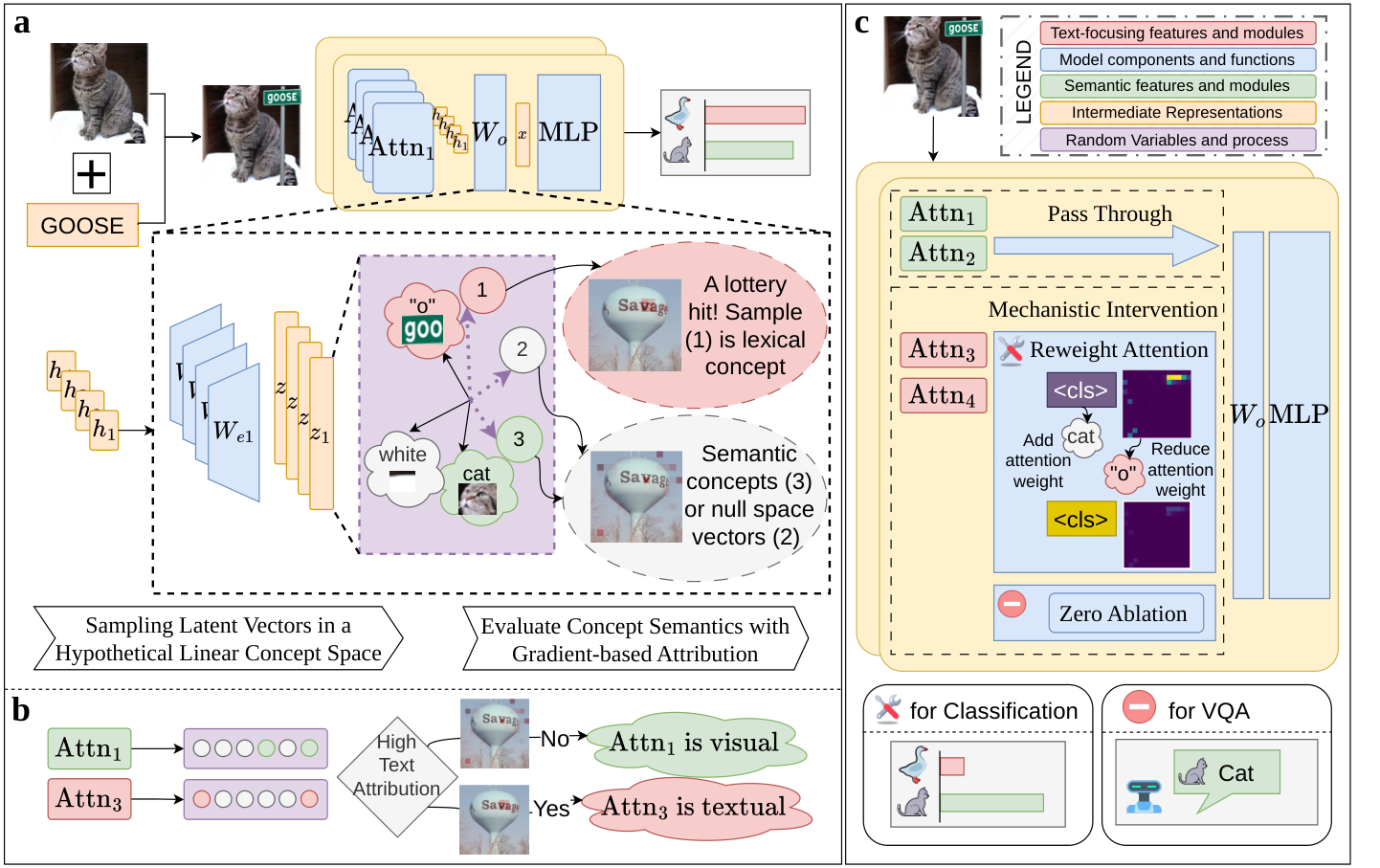
대조 언어-이미지 사전학습(CLIP)으로 훈련된 모델은 현대 대부분의 대규모 시각-언어 모델(LVLM)의 기반 시각 인코더로 사용된다. 널리 채택되었음에도, CLIP 모델에는 치명적이면서도 충분히 탐구되지 않은 실패 모드가 존재한다: 이미지 안에 나타나는 무관한 텍스트가 시각 표현을 교란하여 진정한 시각 의미가 아니라 어휘적 의미로 치우치게 만든다. 이 강건성 문제는 타이포그래픽 공격(Typographic Attack, TA)으로 알려져 있으며, 자율주행과 같은 안전 필수 응용에 중대한 위험을 노출시킨다. TA에 대해 해석 가능하고 효과적인 강건성을 달성하기 위해, 우리는 훈련이 필요 없는 새로운 메커니즘 해석가능성 방법을 제안한다. 본 방법은 은닉 상태 표현에 대한 표본 기반 해석을 제공하고, 개별 어텐션 헤드에 대해 의미 초점 대비 어휘 초점을 정량적으로 귀속시킨다. 확률론적 분석과 서킷 마이닝을 통해 어휘 정보를 불균형하게 많이 인코딩하는 Vision Transformer(ViT)의 특정 구성요소를 분리하여 TA의 메커니즘적 근원을 식별한다. 나아가 추가 훈련 없이 식별된 서킷에 직접 적용하는 간단한 개입만으로 물체 분류에서 TA 강건성을 크게 향상시킬 수 있음을 보인다. 어텐션 가중치의 선택적 조정과 같은 개입은 지도 학습 및 무학습 방어 방법을 모두 능가한다. 실험에서는 제안한 개입을 여러 최신 LVLM의 시각 인코더에 적용하면 RIO-Bench의 TA 간섭 하에서 시각 질의 응답 정확도가 크게 향상됨을 보인다. 이러한 결과는 우리의 메커니즘적 접근의 효과성과 일반화 가능성을 모두 확증한다. 코드는 https://github.com/Liu-524/SamplingTAR에서 공개되었다.
원문 초록 (영어)
Models trained via Contrastive Language-Image Pretraining (CLIP) serve as the foundational vision encoders for most modern Large Vision Language Models (LVLMs). Despite their widespread adoption, CLIP models exhibit a critical yet underexplored failure mode: irrelevant text appearing within images confounds visual representations, biasing them toward lexical meaning rather than true visual semantics. This robustness issue, commonly described as a Typographic Attack (TA), exposes a vulnerability that poses a significant risk to safety-critical applications such as autonomous driving. To achieve interpretable and effective robustness against TA, we propose a novel, training-free mechanistic interpretability method. Our method provides sampling-based interpretations of hidden state representations and quantitatively attributes semantic versus lexical focus to individual attention heads. Through probabilistic analysis and circuit mining, we isolate specific Vision Transformer (ViT) components that disproportionately encode lexical information, thereby identifying the mechanistic source of TA. We further show that simple interventions applied directly to the identified circuits, without any additional training, can substantially improve robustness against Typographic Attacks in object classification. These interventions, such as selective adjustment of attention weights, also outperform both supervised and training-free defense methods. Our experiments demonstrate that applying the proposed intervention to the vision encoders of several state-of-the-art LVLMs yields substantial gains in Visual Question Answering accuracy under Typographic Attack interference on RIO-Bench. These results confirm both the efficacy and the generalizability of our mechanistic approach. Code is released at https://github.com/Liu-524/SamplingTAR.
이 논문의 기여
이미지에 그려진 텍스트가 모델이 보는 것을 결정해서는 안 됩니다. 우리는 주입된 단어를 읽는 소수의 CLIP 어텐션 헤드를 학습 없이 찾아내고, 이들을 재가중치하거나 제거합니다. RTA-100(ViT-H/14)에서 객체 정확도 +22.8점을 추론 비용 거의 없이 달성하며, 5개 백본에서 지도 학습 및 무학습 방어를 능가합니다.
BibTeX
@inproceedings{liu2026typographic,
  title     = {Towards Robustness against Typographic Attack with Training-free Concept Localization},
  author    = {Bohan Liu and Wenqian Ye and Guangzhi Xiong and Zhenghao He and Sanchit Sinha and Aidong Zhang},
  booktitle = {European Conference on Computer Vision (ECCV)},
  year      = {2026},
  url       = {https://arxiv.org/abs/2607.02494}
}